
5 Material Handling Crane Types for Warehouses
Efficiency is the lifeblood of any modern warehouse. When standard forklifts and manual labor hit their vertical or weight limits, overhead lifting systems step in. Cranes play a pivotal role in optimizing warehouse throughput, minimizing floor congestion, and maintaining rigorous safety standards. Beyond single facilities, cranes are indispensable across global industries—from manufacturing and heavy construction …
Efficiency is the lifeblood of any modern warehouse. When standard forklifts and manual labor hit their vertical or weight limits, overhead lifting systems step in. Cranes play a pivotal role in optimizing warehouse throughput, minimizing floor congestion, and maintaining rigorous safety standards.
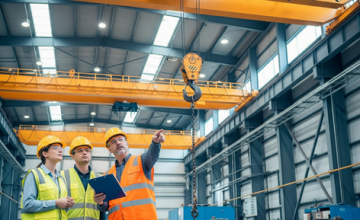
Beyond single facilities, cranes are indispensable across global industries—from manufacturing and heavy construction to logistics and shipping ports. However, because materials, building dimensions, and operational paces vary wildly, no two cranes are built exactly alike. Each system is customized to match specific facility layouts, duty cycles, and hook heights. Choosing the right configuration is critical to keeping your daily operations seamless, safe, and cost-effective.
What Are Warehouse Cranes?
In technical terms, a warehouse crane is a specialized material handling machine designed to lift, lower, and horizontally transport loads within a defined spatial boundary. Unlike massive, outdoor construction cranes (such as tower cranes or mobile crawler cranes), warehouse cranes are engineered specifically for indoor facility constraints, maximizing hook height beneath lower ceilings and navigating around dense storage racks.
4 Key Features That Define a Warehouse Crane
- Defined Spatial Footprint: They operate along fixed structural paths, runways, or localized pivoting radii.
- Vertical Space Optimization: They utilize the dead space near the ceiling, leaving the floor lanes entirely clear for foot traffic and smaller industrial vehicles.
- Precise Load Spotting: Equipped with motorized trolleys and fine-tuned hoists, they allow operators to position heavy goods down to the millimeter.
- Structural Integration: They either tie directly into the building’s structural columns or rely on self-supporting freestanding frames to manage extreme vertical loads.
5 Types of Warehouse Cranes
Standard Overhead Cranes
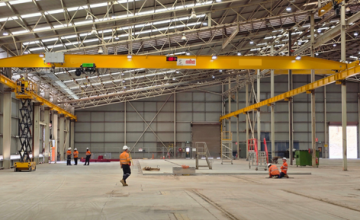
Standard overhead cranes, often called bridge cranes, utilize a traveling bridge that rides on parallel overhead runways integrated into the building’s support structure.
These systems generally fall into two main design configurations:
- Single Girder Cranes: These bridge cranes use a single main beam (girder) to support the traveling trolley and hoist. The hoist assembly usually travels along the bottom flange of this single beam. They are highly popular because they offer a lightweight, cost-effective lifting solution perfectly suited for light to medium-duty applications.
- Double Girder Cranes: Featuring two parallel support beams instead of one, these cranes are engineered for heavy-duty material handling. The hoist and trolley typically ride on top of the two beams, allowing for greater hook height and the structural strength needed to lift extreme weights across long spans.
Engineered Cranes
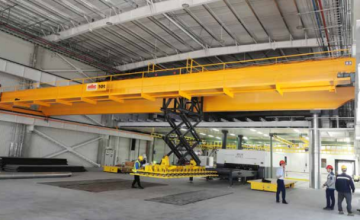
When an off-the-shelf or modular system falls short, an engineered crane is required. These are custom-designed lifting systems built from the ground up for highly specific industrial, manufacturing, or heavy-construction applications.
Unlike mass-produced units, every element of an engineered crane is tailored to handle unique load capacities, extreme or hazardous environments (such as chemical exposure or intense heat), precise duty cycles, and complex spatial constraints.
Gantry Cranes
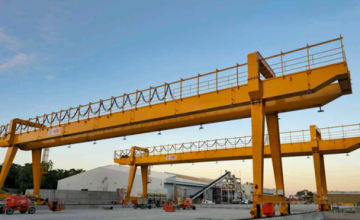
A gantry crane is a heavy-duty material handling system built around a “portal” or door-frame structure. Instead of riding on elevated, building-supported runways, a gantry crane features a horizontal main beam supported by its own freestanding legs.
These legs travel along ground-level wheels, embedded tracks, or steel rails. A hoist and trolley move laterally across the bridge beam to lift and position materials. Gantry cranes are excellent options if your facility cannot support the overhead loads of a bridge crane or if you require a lifting solution that can easily be relocated.
Slewing Jib Cranes
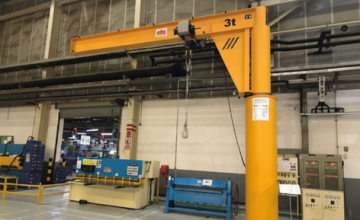
Also known as swing jib cranes, these are specialized material handling devices used to lift, lower, and transfer loads within a localized workspace or assembly cell.
A slewing jib crane features a horizontal boom or “jib” arm fitted with a moveable hoist. This arm is designed to pivot or “slew” around a central vertical support, which can be a freestanding floor-mounted pillar or a wall-mounted bracket fixed to an existing structural column. They provide dedicated lifting power to a specific area without tying up the main overhead crane.
Light Crane Systems
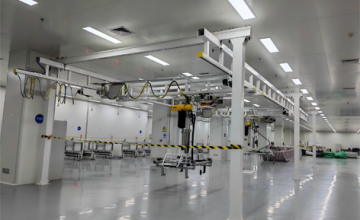
Ideal for low-profile facilities and light-duty operations, a light crane system excels in environments where heavy, traditional overhead cranes are unfeasible.
Thanks to a modular and highly adaptable design, these systems are remarkably easy to assemble, maintain, and expand. If your plant layout or production flow changes down the line, the tracks can be rearranged or upgraded seamlessly, helping you avoid costly reinvestments. They are available in several versatile configurations, including single-rail monorails, single-girder suspension cranes, and double-girder suspension designs.
How to Choose the Right Crane for Your Warehouse
Selecting the optimal crane configuration prevents structural damage, limits equipment wear, and ensures maximum workplace safety. Use these four evaluation steps to guide your choice:
Determine Your Load Specifications
Identify the absolute maximum weight of the heaviest load you will ever need to lift. Once you have that number, always add a safety margin (typically 10% to 25%) to account for structural impact factors, dynamic motion, and future-proofing.
Match the Crane Type to Your Warehouse Structure
Assess what your building can safely handle. Overhead bridge cranes require heavy, load-bearing building columns capable of handling both the weight of the crane and its payload. If your building cannot support these forces, a floor-supported gantry crane or a freestanding light crane system is often the safer, more practical choice.
Assess the Working Envelope
Map out the exact physical footprint your lifting needs require. You must accurately measure the width of your bays (the span the bridge must cover) as well as the total horizontal and vertical travel distances needed to clear your highest storage racks.
Determine Your Duty Cycle
How often and how intensely will the crane be operated? A high-frequency, continuous-use industrial workflow requires robust, heavy-duty components to minimize wear and tear. Matching your operation to the correct Crane Manufacturers Association of America (CMAA) service class ensures your equipment lasts without unexpected, costly downtime.
Partner with the Right Material Handling Expert
Designing and implementing the perfect overhead lifting system requires deep engineering expertise and reliable equipment. MHE—a Jebsen & Jessen brand—is the premier material handling partner to help optimize your facility.
We don’t believe in one-size-fits-all hardware. We customize each crane solution according to your exact operational needs, facility dimensions, and budget constraints. Ready to upgrade your warehouse efficiency and safety?
Contact us today to speak with a dedicated lifting specialist.